Enter a search phrase
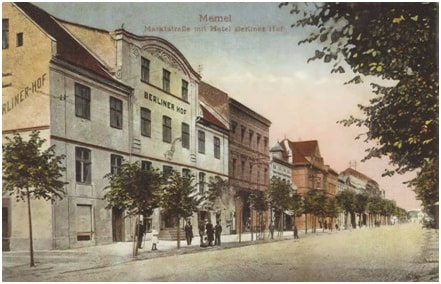
The building at 3 Turgaus St.
Coordinates: 55.708111 21.133194
Object address: Turgaus gatvė 3, Klaipėda, Lietuva
Municipality: Klaipėda
The building in this place was mentioned for the first time in 1786, and in 1858, the owner was John Mason, a British merchant and a commercial adviser. He was the owner of the “The British Hotel” (former Marktstrasse No. 48/49), which was opened in this house. The hotel changed owners several times, and in 1915 was renamed to “Berliner Hof”. In the building there were apartments for rent and offices for the provision of various services: a hairdresser, a dentist, and a tailor lived and worked there. There were customs broker’s offices, the company store of the Memel textile factory, a shoe store, a radio set repair shop, and an office of a fertilizer company in the building. In address books of 1920-1939 Lithuanian, German and Jewish surnames are found.
After World War I, Klaipėda region was separated from Germany, and was administered by France in 1920-1923. In 1921, in this building, the Lithuanian press publication and trade company “Rytas” (liquidated in 1939) was located, which also had its own hotel by the same name. It is believed that Antanas Smetona lived here for a short time in 1923, as the High Representative of the Lithuanian Government for Klaipėda Region, when he negotiated with the French Prefect Petisné. In 1925, the “Elta” telegraph agency operated in the building. In 1935, the honorary consul of the Czech Republic and Slovakia worked here. Between the wars, there was “The Britisch Tunnel” restaurant in this building, which name was changed for “The Berliner Tunnel” during World War II.
The building was rebuilt after the war. Its facade was changed, the height of individual parts of the building was unified, the decor of the central part of the building was eliminated, and balconies were added. After 1990, the ground floor of the building housed a cafe and a sporting goods store. In 2011, an amber art gallery – store “Amber Queen” and in 2013 the private Amber Museum were opened here.
Object on the route "I loved you, Klaipėda..." (for Ieva Simonaityt)
In this building Ieva Simonaitytė worked in the editorial office of ‘The Voice of Prussians’ in 1922. After the annexation of Klaipėda region to Lithuania in 1923, I. Simonaitytė continued to work in the editorial office, only in the position of the editor of the newspaper until 1924.
Object on the route "Literary Klaipėda between the wars"
In this building, when the company “Rytas” operated here, 180 books for Lithuania Minor and about 200 books for Lithuania Proper were published. The company also published the newspapers ‘Lietuvos keleivis’ (1924-1939), ‘Klaipėdos žinios’ (1924-1926), ‘Darbininkų balsas’ (1931-1933, 1935-1939), ‘Vakarai’ (1936-1938), ‘Baltischer Beobachter’ (1936-1939), ‘Pagalba’ magazine (1923-1932), etc. The ‘Rytas’ company published the newspaper of the Lithuanian national movement the ‘Prussian Lithuanian Voice’ in 1920-1923.
Adomas Brakas, Viktoras Gailius, and Jokūbas Stikliorius worked in the ‘Rytas’ company, and many other writers also collaborated in the publications.
Ieva Simonaitytė (1897–1978) is a writer from Klaipėda region, the author of autobiographical short stories and novels, a portrayer of everyday life of Lithuanians of Lithuania Minor in Lithuanian prose. She participated in the cultural activities of Lithuanians of Klaipėda region, in the Vanagai village Lithuanian youth group ‘Eglė’, and actively opposed the germanization. She collaborated in the Lithuanian press of Lithuania Minor, ‘Tilžės keleivis’, etc. In 1921-1938 I. Simonaitytė lived in Klaipėda. She worked at the Lithuanian Consulate, as a proofreader at the ‘Rytas’ printing house, in the editorial office of the ‘Prūsų lietuvių balsas’, later at the Klaipėda Regional Directorate, as a typist and translator at the Seimelis office. In this building Ieva Simonaitytė worked in the editorial office of the ‘Prūsų lietuvių balsas’ in 1922. After the annexation of Klaipėda region to Lithuania in 1923 I. Simonaitytė continued to work in the editorial office, only in the position of editor of the newspaper until 1924.
Balys Sruoga (1896–1947), a doctor of philosophy, creator of symbolist poetry, prose writer, dramatist, theater critic, literary critic, and folklore researcher, lived in Klaipėda just for a short period of his life. In 1922, he wrote the libretto for Stasys Šimkus opera based on J. Žiliaus-Jonila poem ‘Vestuvės’. In 1923, B. Sruoga’s book ‘Dievų takais’ was published at the ‘Rytas’ printing house. Since spring of 1924, B. Sruoga started working in the editorial office of the daily ‘Klaipėdos žinios’, established by the Lithuanian government, and became its actual editor. B. Sruoga himself wrote quite a lot in the ‘Klaipėda žinios’. These were publications on the topics of public life, art, reviews, and articles about writers. In autumn of 1924, B. Sruoga moved to Kaunas, but maintained close relations with I. Šeinius.
Petras Tarasenka (1892–1962), a military officer, archaeologist, museologist, and a writer, lived in Klaipėda in 1923-1926. In 1924-1925, he actively collaborated with the newspaper ‘Klaipėdos žinios’, wrote articles about archaeological monuments of the pre-coastal region, and contributed a lot to the establishment of the Museum of History and Archeology in Klaipėda in 1925. (‘Klaipėda needs a museum of history and archaeology’, ‘Klaipėda Museum Society’, ‘What Klaipėda City Museum should be’). A commemorative plaque dedicated to Petras Tarasenka was unveiled on the building of the Institute of History and Archeology of the Baltic Region of KU.
Mikas Otonas Gudaitis (1880–1941), a journalist, prose writer, and social activist; and the chief editor of the ‘Lietuvos keleivis’ in 1927-1929. He published historical, journalistic works and works of fiction at his own expense. 4 short stories are published in the book ‘Stories from the Life of Prussian Lithuanians’ (1920). This is the most significant book by Prussian Lithuanians artists published before the maturity of I. Simonaitytė’s talent. In 1925, his booklet ‘Lithuania in 1917. Travels around Lithuania during the German occupation’ was published in Klaipėda.
Gustavas Juozupaitis (ps. Sėjus) (1895–1954), a public figure in Lithuania Minor, an economist, and a poet. In 1924-1926, he edited the newspaper ‘Klaipėdos žinios’. 1924-1925 together with J. Stiklorius, he founded a limited liability company ‘Sargas’ to publish various types of press and published the unpopular newspaper the ‘Pajūrio sargas’, an ally to the politics of the Lithuanian government. In 1939, he became the editor of the Lithuanian trend newspaper the ‘Baltischer Beobachter’. On the occasion of the annexation of Klaipėda region to the Republic of Lithuania, he wrote poems, they were published mainly in the newspapers of Lithuania Minor: the ‘Prūsų Lietuvos savaitraštis’, the ‘Prūsų lietuvių balsas’, the ‘Rytojus’ and the ‘Nauja lietuviška ceitunga’, and calendars. All published poems are lyrical and patriotic.
Butkų Juzė (real surname Juozas Butkus) (1893–1947), a poet, playwright, translator, and pedagogue. The writer lived and worked intermittently in Klaipėda. Before the war, he taught the Lithuanian language and literature at Klaipėda Lithuanian Gymnasium and worked at the ‘Klaipėda News’, where he published his poems and works of fiction. Butkų Juzė edited the ‘Darbininkų balsas’, but after a few years, when the nationalists took over the ‘Rytas’ printing house, he was dismissed from his work. Commemorating the memory of Butkų Juzė a street was named after him in Klaipėda, and a bas-relief has been unveiled on the wall of a building standing at the intersection of S. Nėries and Butkų Juzė streets.